Student Competition - Ideas for Urban Lakes
December 2025
The Centre for Water and Sanitation (CWAS), CRDF, in partnership with the Faculty of Planning at CEPT University, Ahmedabad organized a student competition inviting ideas for improving the conditions of urban lakes.
India's lakes are facing unprecedented challenges due to rapid urbanisation, industrial growth, agricultural pressures, and climate change. Studies across major cities in India (Ahmedabad, Bengaluru, Chennai, Delhi, Hyderabad) report decline in lake surface area by 50-90% in the past 50 years.
Despite their critical role in providing essential ecosystem services ecosystem services such as drinking water, flood control, biodiversity habitats and carbon sequestration, the management of this vital resource remains ineffective. This leads to degradation by pollution, encroachment, over-extraction and reduced water quality.
There is a pressing need for innovative approaches that can support community involvement, data-driven decision-making, and collaborative governance. At the national level, the Government of India has acknowledged the need for systematic revival of traditional lakes, ponds, and reservoirs through multiple policy and programme interventions. Missions such as AMRUT 2.0 place emphasis on rejuvenation of water bodies as a key urban infrastructure component, while schemes under the Jal Shakti Abhiyan focus on renovation, geo-tagging, inventory creation and scientific restoration.
This student competition aimed to harness the creativity, technical knowledge and fresh perspectives of young researchers to develop actionable ideas and innovations for improving lake governance and enhancing lake health. Students enrolled in universities and colleges across varied domains – planning, architecture, engineering, technology, management – all were invited to submit entries.
40
Entries Received
90+
Student Participants
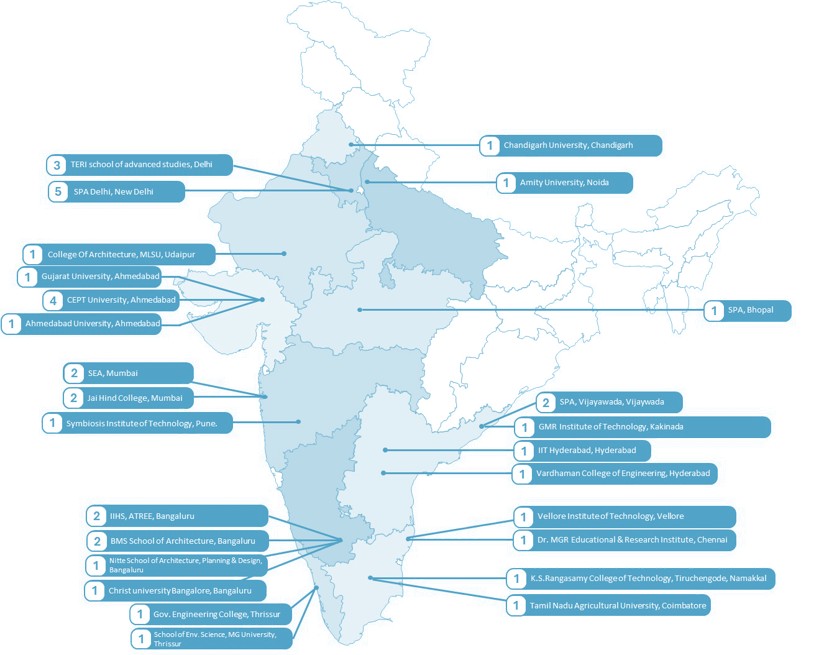
26
Institutions Represented
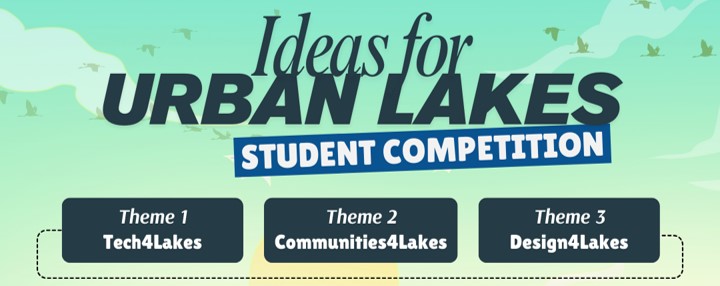
Theme1-Tech4Lakes: Leveraging technology for lakes including AI/ML, citizen-facing digital tools like apps and gamified platforms, IoT-based sensing systems for real-time data, decision-support tools, and treatment technologies.
Theme2-Communities4Lakes: Strengthening community participation with volunteer safeguarding efforts, citizen-led monitoring, cultural and heritage connections through storytelling, festivals etc.
Theme3-Design4Lakes: Integrating lakes into urban planning and design through governance frameworks, policy and institutional models, and approaches such as water-sensitive urban design and nature-based solutions for green infrastructure.
8 Jan ’26
Call for Expression of Interest
15 Feb ’26
Round 1 Proposal submissions
10 Mar ’26
First Round Results
21 Mar ’26
Final Round – World Water Day
On the occasion of World Water Day, the final jury of the competition was held at CEPT University.
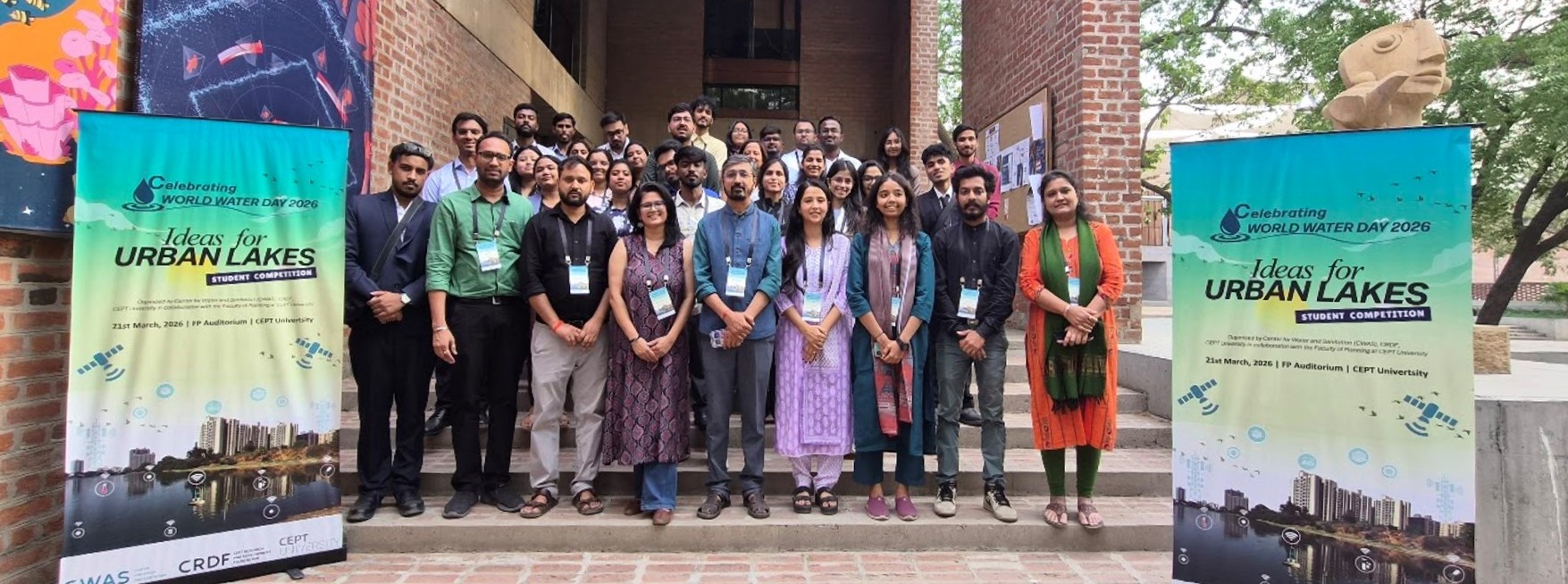
Awardees

Low-cost IoT-Based Real-time Monitoring and BOD Prediction System For Urban Lakes
Jheel Khandelwal - Jai Hind College
Nidhi Shetty - Viva Institute of Technology
Urban Lakes – A Choice of Neglect
Urnaba Das Roy, Smiksha Verma, Shreya Datta, Vanshita Jain
Faculty of Planning, CEPT University

UrbanLakeWatch: An automated Web-based platform for urban lake monitoring
Animesh Pramanik - IIHS
Sudip Banerjee - Birla Institute of Technology, Mesra
Community Safeguarding of Urban Lakes Through Local Institutions
Ayush Basu Sengupta, Chinmayee Kalangutkar, Priyanshu Kundalia
School of Planning and Architecture, Delhi

Integrated Biodiversity – Focused urban lake and wetland design framework
Arjun R. - Christ University, Bangalore
Resilient Lakescapes of Mehrauli: Green infrastructure and water sensitive urban design approaches
Udisha Sarkar, Adarsh Kumar
School of Planning and Architecture, Delhi
Reviving the Historic Cascade: Urban Renewal through Bhopal’s Historic Lakes
Shrivallabh Kukde, Atrayee Baruah
School of Planning and Architecture, Bhopal
Urban lake digital twin framework for Bellandur Lake, Bangalore
Nikitha Senny, Dhanushree NV.
School of Planning and Architecture, Vijayawada
Other Finalists
Socio-Ecological Synthesis (SES): An Integrated Nature-Based and Regulatory Framework for Urban Lake Revitalization
Riya Verma, Shagun Singh, Ravia Kaur, Rajat Singh Bhandari, M S Anandhu
TERI School of Advanced Studies
Revitalizing Traditional Water Systems for Urban Water Security
P. Vaishnavi
School of Planning and Architecture, Delhi
Reclaiming Urban Lakes as Living Infrastructure to better represent a holistic approach to non-negotiable pillars of urban lake
Vijaya Meghana Raavi, Mohammed Khan, Sanidhya Joshi
TERI School of Advanced Studies
Filtering Stormwater Inflow Into Lakes Using Constructed Wetlands as NBS
Amogh Coca, Priyansh Singh
CEPT University, Ahmedabad
Lakes Sponge Edges: A Nature-based Blueprint for Urban Lake Revival
Darshan Gowda, Abdul Mannan, Balaji D, Cherishma V, K S Dayanand, Kishore B, Preetham Gowda G R, Pruthvi G, Suhas Nayak
Nitte School of Architecture, Planning and Design, Bangalore
