
WASH Economics Conference 2026
17 – 18 April 2026 | CEPT University, Ahmedabad (India)
The fourth edition of the WASH Economics Conference was held on April 17-18, 2026 at CEPT University, Ahmedabad, India
The fourth edition of the WASH Economics Conference was organised by the Center for Water and Sanitation (CWAS) and Faculty of Planning at CEPT University, in collaboration with the Institute for Fiscal Studies (IFS), and the London School of Hygiene & Tropical Medicine (LSHTM). It was co-funded by the Gates Foundation. The conference took place on April 17-18, 2026 at CEPT University, Ahmedabad, India which brought together more than 100 participants including academics, practitioners and sector partners doing research on the economics of water supply, sanitation, and hygiene/health services (WASH).
The conference included sessions on areas of WASH economics and WASH financing from researchers, practitioners and development sector partners working on economic issues within as well as disciplines beyond economics (e.g. engineering, public health). The keynote and a panel discussion also provided key insights and valuable perspectives which set the tone for the broader discussions at the conference. Around 23 participants presented their work, followed by reflections from pre-identified discussants and open discussions. The conference also saw strong international participation, with attendees joining from across the globe, including Australia, Bangladesh, Sweden, United States, United Kingdom, Zambia and many others.
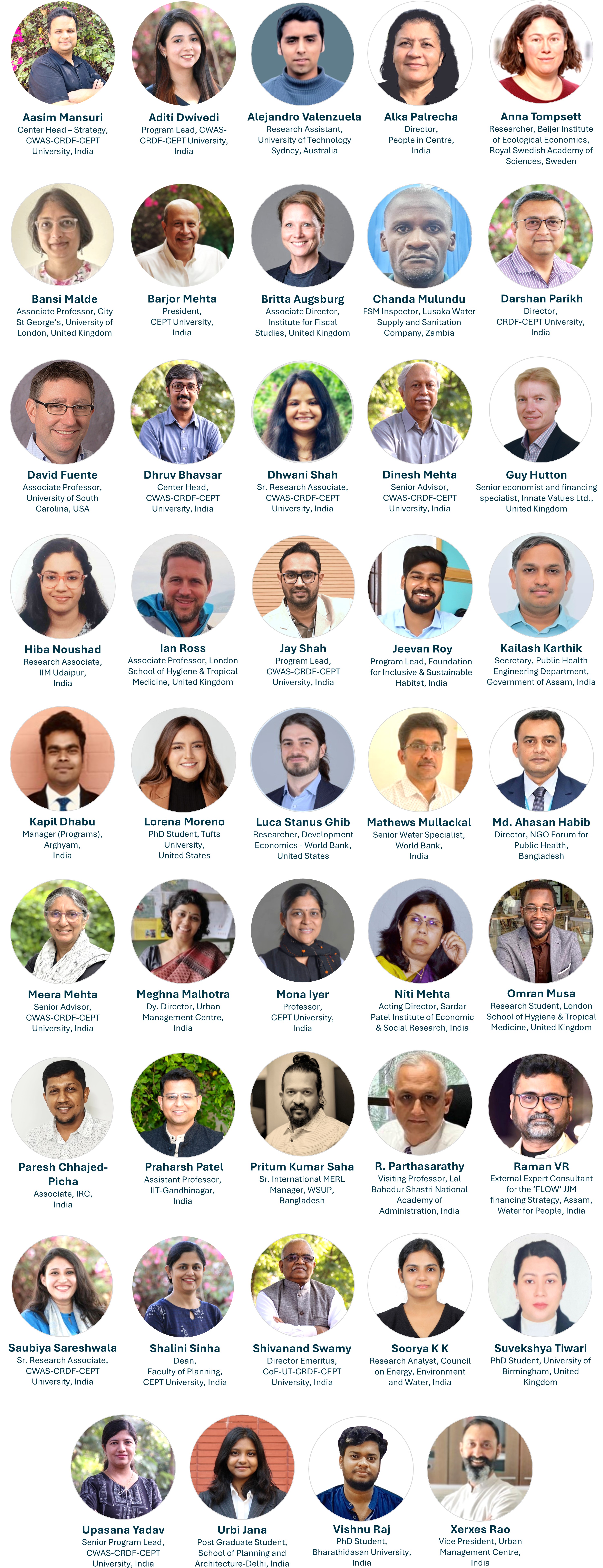
Speakers at the Conference
Presentations
Keynote address
What Role Can Economic Analysis Play in WASH Decision Making? | Guy Hutton | Innate Values Ltd.
Session 1
Economies of scale and the equity-efficiency trade-off: Evidence from a piped water network in rural Bangladesh | Anna Tompset | Beijer Institute of Ecological Economics, Royal Swedish Academy of Sciences
Decomposing Household-level WASH Expenditure: A Comparative Analysis of Economic and Sociocultural Determinants in Tamil Nadu | Vishnu Raj | Bharathidasan University
Is menstrual health under-represented in the Global Burden of Disease? An exploration of weights for disability-adjusted life years | Ian Ross | London School of Hygiene & Tropical Medicine
Sustaining Shared Sanitation: The Critical Role of O&M Financing in Improving User Quality of Life in Informal Settlements | Pritum Kumar Saha | Water & Sanitation for Urban Populations
Session 2
Economics in WASH – A Case Study of Scheduled Desludging in Lusaka Province | Chanda Mulundu | Lusaka Water Supply and Sanitation Company
Navigating Political–Economic Complexities in Implementing Climate-Resilient WASH Services in Small Towns | Jeevan Roy | Foundation for Inclusive & Sustainable Habitat
Climate Risk Assessment: A Tool for Prioritising and Financing WASH Programmes | Soorya K K | Council on Energy, Environment and Water
Assessing Cost Recovery and Collection Efficiency for water and sanitation services for Indian cities | Dhwani Shah, Jay Shah and Saubiya Sareshwala | CWAS, CRDF, CEPT University
Session 3
Time is not money: an experiment with community contribution requirements in cash and labour | Md. Ahasan Habib | NGO Forum for Public Health
Water Access and Time Allocation: Evidence from the Jal Jeevan Mission | Hiba Noushad | IIM Udaipur
Session 4
Advancing Mechanisation for Safe and Dignified Sanitation Work in Urban India: Framework and Cost Estimation through the Swachh Mech Tool | Xerxes Rao | Urban Management Centre
Willingness to Pay for Upgrading On-Site Sanitation: Evidence from Alappuzha, Kerala | Paresh Chhajed and Zachary Burt | IRC
Development of Assam State’s Financing Strategy for Sustaining the Benefits of Universal Piped Drinking Water Supply under the Jal Jeevan Mission | V R Raman | Water for People
Understanding the life-cycle cost of climate-resilient sanitation: lessons from Laos, Solomon Islands, and Bangladesh | Alejandro Valenzuela | University of Technology Sydney
Session 5
Reimagining Utility Sustainability: A Conceptual Framework for Performance-Linked Water Financing Instruments | Kapil Dhabu | Arghyam
The role of benefit-cost analysis in water supply and sanitation decisions: A qualitative study in three multilateral development banks | Omran Musa | London School of Hygiene & Tropical Medicine
Re-evaluating Wastewater Reuse as a Business Case in Urban India | Alka Palrecha | People in Centre
Planning framework for Ageing Drainage Infrastructure in Indian Cities | Urbi Jana | School of Planning and Architecture - Delhi
Session 6
A Critical Review of Model-Based Economic Evaluations in Water, Sanitation and Hygiene (WASH): Methodological Challenges and Recommendations | Suvekshya Tiwari | University of Birmingham
At-Scale Implementation and the Perils of Fragmentation: Evidence from Rural Sanitation | Bansi Malde and Britta Augsburg | City St George’s, University of London
Forgive us our sins | David Fuente | University of South Carolina
Unsafe Waters: The Hidden Costs of Seasonal Drinking Water Contamination in Ecuador | Lorena Moreno | Tufts University
Know more about previous conferences
WASH Econ 2025
The 2025 edition took place at Oberlin College, USA.
WASH Econ 2024
The 2024 edition took place at the Aix-Marseille School of Economics, France
WASH Econ 2023
The 2023 edition took place at the London School of Hygiene & Tropical Medicine, UK.
Organizers
