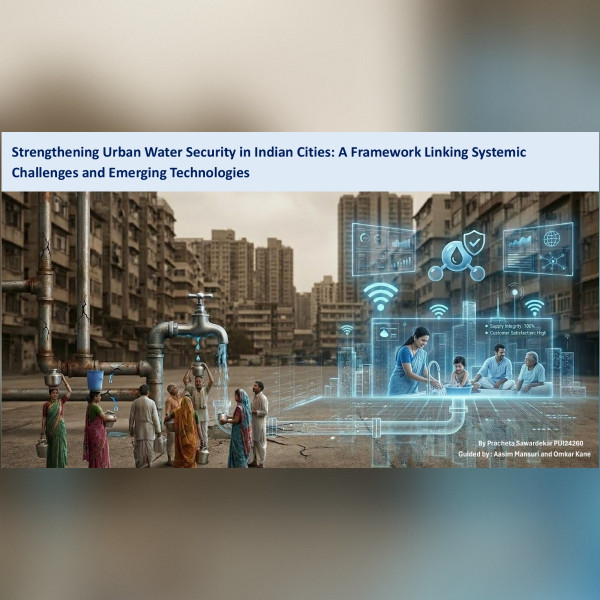
Strengthening Urban Water Security in Indian Cities - A Framework Linking Systemic Challenges and Emerging Technologies
May 2026
Urban water security in Indian cities is under threat due to rapid urban growth, climate variability, old infrastructure and fragmented water governance systems. As a result, the urban water service chain exhibits significant inefficiencies such as over reliance on non-traditional water sources, high levels of non-revenue water, uneven service distribution, and limited monitoring capacity. The study uses national and global case studies such as Nagpur, Chennai and Gurugram in India and Singapore, Perth and Copenhagen internationally to map the reasons behind water insecurity and the consequences of interventions attempted to address it. Hence, the study finds that merely building more infrastructure will not solve water insecurity; it needs a multi- disciplinary approach.
To address these shortcomings, a decision-support framework is developed that seeks to address both systemic challenges and technology solutions within a context specific framework across the water service chain from source abstraction to wastewater reuse. Technologies are categorised into three functional groups: source augmentation, efficiency enhancements, and monitoring and decision-support technologies, and evaluated for feasibility, scalability and institutional capacity.This framework is then applied to two Tier 3 cities in Western India, Gandhidham and Ichalkaranji to understand system gaps and formulate interventions. The analysis underlines that water insecurity in urban settings is structural and therefore needs integrated interventions combining technology and governance. This framework helps Urban Local Bodies (ULBs) to transition to proactive, data driven and resilient water management through a structured methodology and holistic integration of innovation and governance.