Methane Recovery in Sewage Treatment: Insights from Indian Cities
June 2026
Indian cities are rapidly expanding wastewater treatment infrastructure under national programmes such as AMRUT, the Namami Gange Mission, and the Swachh Bharat Mission (SBM) 2.0. As treatment capacity grows, methane recovery from sewage treatment plants (STPs) presents a significant opportunity to reduce greenhouse gas emissions, generate renewable energy, and improve the financial sustainability of urban sanitation services. This landscape study documents methane recovery practices from six selected Indian cities and examines the technical, operational, governance, financial, and monitoring factors that influence methane recovery performance.
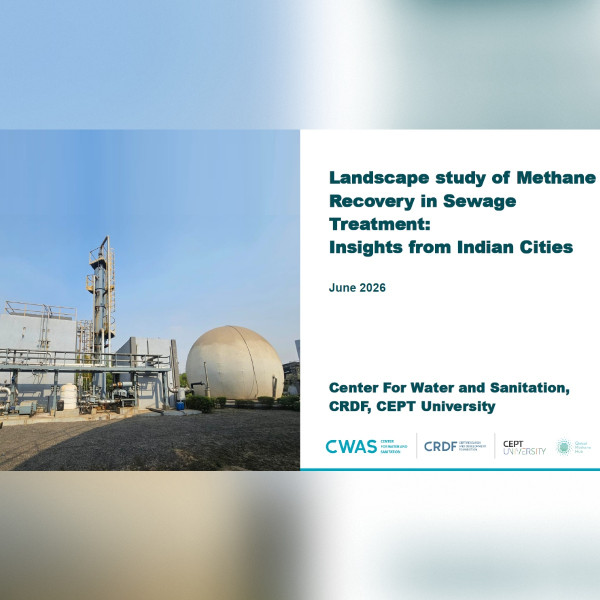
The study highlights that while proven technologies, enabling policies, and government schemes exist to support methane recovery, several challenges continue to limit large-scale adoption. These include issues related to plant operations and maintenance, business models, contractual arrangements, monitoring systems, and institutional capacity. Drawing on site visits, stakeholder consultations, and case study analysis, the study identifies key barriers faced by cities and explores how these challenges can be converted into opportunities. The findings provide practical insights and actionable recommendations to improve methane capture, strengthen resource recovery, reduce operational costs, and support the transition of STPs from wastewater treatment facilities to climate-responsive resource recovery systems across India.