Maharashtra’s journey to move towards ODF+/ ODF++ through faecal sludge and septage management
January 2023
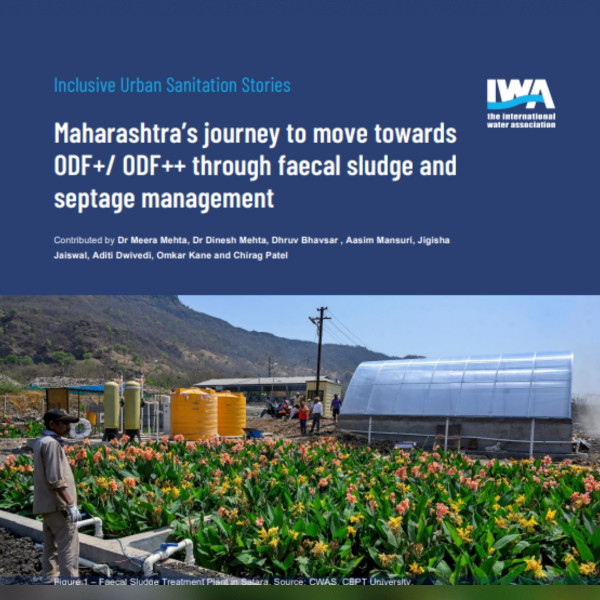
Maharashtra is the second most urbanized state in India with a population of 64 million living in 412 cities regulated by their respective Urban Local Governments. The state was awarded the status of Open Defecation Free (ODF) in October 2017 and has continually focused on improving the entire sanitation service chain. Since 300+ cities in Maharashtra depend completely on onsite sanitation, a considerable focus on Faecal Sludge and Septage Management (FSSM) is needed to achieve safe sanitation. Therefore, the Government of Maharashtra’s has developed a robust strategy to strengthen the Faecal Sludge and Septage Management system in order to remodel as ODF+ and ODF++. With 214 functioning Faecal Sludge Treatment Plant (FSTPs) and another 22 under construction out of a proposed 311 FSTPs, Maharashtra has performed remarkably in its ongoing journey from ODF to ODF+ /ODF++1. For efficient result, under the flagship Swachh Maharashtra Mission for Urban Areas (SMMUA) 1.0, a Technical Support Unit (TSU) had been established under the Urban Development Department (UDD). Our organization, the Center for Water and Sanitation (CWAS), CEPT University, acts as a TSU and extensively supports the Government of Maharashtra in implementing urban sanitation improvement measures in urban areas of Maharashtra with a determined focus on FSSM. Furthermore, in the next phase of SMMU, CWAS has signed MOU with the UDD Maharashtra, with the commitment to extend their support for further improvement with a focus on the parameters of Citywide Inclusive Sanitation in small and medium cities that are dependent on onsite sanitation. In this story we will bring to light Maharashtra’s journey of urban sanitation in an incisive manner so that it can be used as a knowledge product to inspire other states, government officials and practitioners. For good measure, the best practices from Maharashtra can be replicated in any other states in India fostering cross learning among them.
You can read the article here.