Climate Responsiveness of ULBs and Vulnerable Communities
May 2026
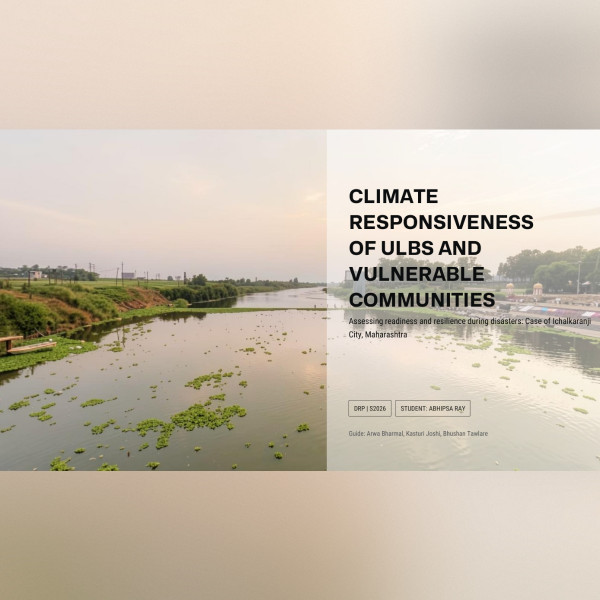
This study aims to examine the climate responsiveness and disaster preparedness of Urban Local Bodies (ULBs) and the communities most at risk in Ichalkaranji, with a focus on flood vulnerability. The city is situated on the Panchganga river basin, affected by floods every monsoon due to heavy rainfall, upstream dam releases, drainage blockages and backflow. The study uses a multi-lateral approach that includes literature and case study review, institutional and spatial mapping, and discussions with the vulnerable communities and NGOs.
The results show that institutional response measures, especially in the case of evacuation and emergency management, are comparatively well-developed, but there are gaps in long-term preparedness, urban infrastructure resilience, and recovery. Riverine flooding and urban waterlogging emerge as two distinct flood types: affecting evacuation-prone settlements and non-evacuated low-income areas, respectively.
Locals have strong coping strategies, including evacuation preparedness and short-term coping strategies, but long recovery times and repeated losses.
The research identifies key gaps between planned systems and on-ground realities, especially in the areas of infrastructure exposure, local governance, and community resilience. Current on-going initiatives like the Maharashtra Resilience Development Program (MRDP) have the potential to improve the situation, but the response remains highly reactive. The study ends with recommendations for better intra- governance coordination and community recovery to reduce disaster risk.